
ICC Men's T20 World Cup 2026 - Match 55 : India beat New Zealand by 96 runs — History Repeated, History Defeated, New History Created
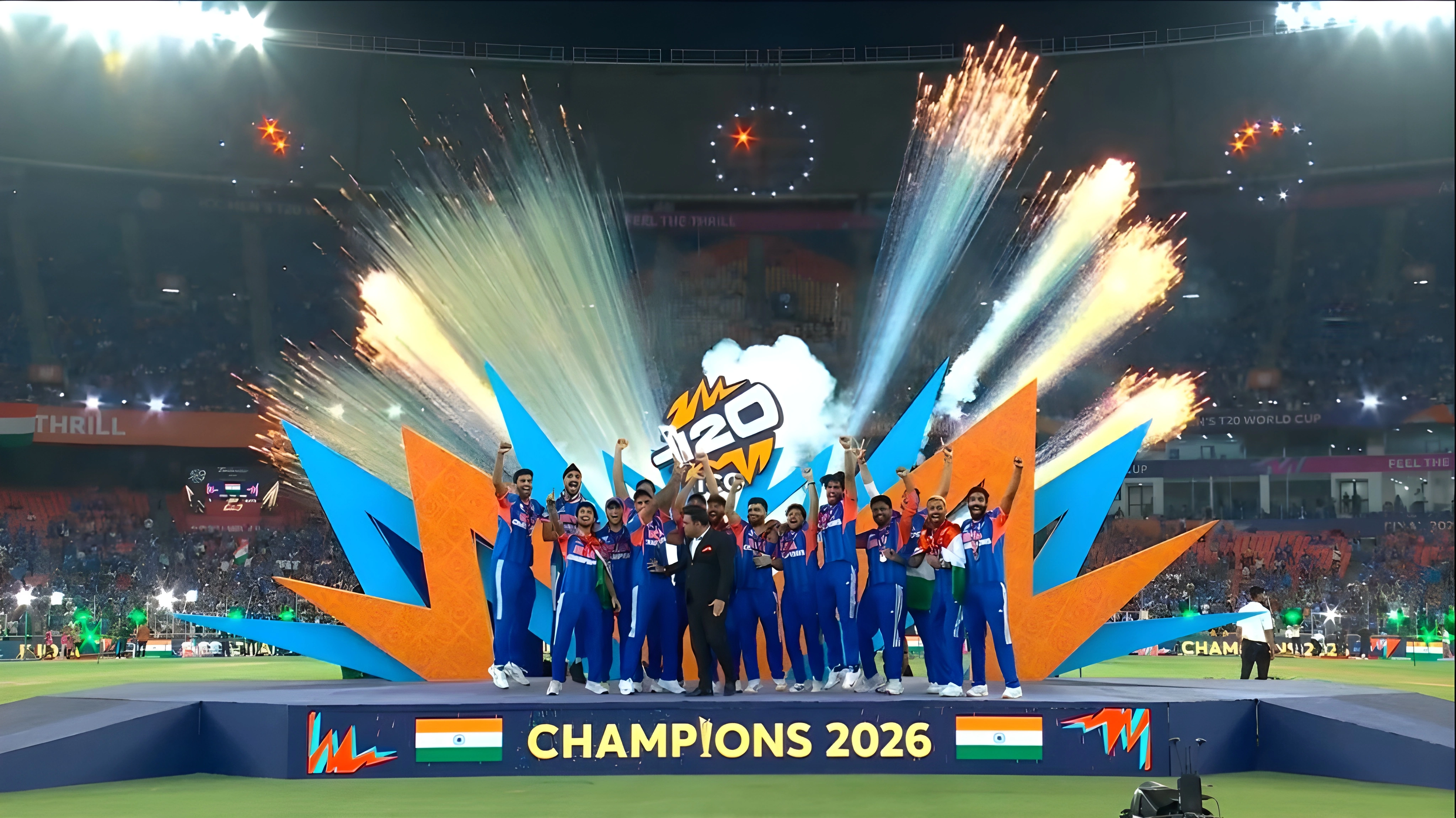
India Beat New Zealand by 96 Runs — Triple Champions! Samson, Abhishek, Ishan, Bumrah and Axar Seal India's Historic Third T20 World Cup Title at Ahmedabad
History Repeated, History Defeated, New History Created
When Rohit Sharma stood before a camera ahead of the ICC Men's T20 World Cup 2026 and declared with quiet, steely certainty — "History Repeat karenge, History Defeat karenge" — few could have known just how completely, how ruthlessly, and how historically the words of India's former champion captain would come to define the entire tournament. On March 8, 2026, at the Narendra Modi Stadium in Ahmedabad — the very ground where India had suffered ODI World Cup Final heartbreak against Australia in 2023 — Suryakumar Yadav's India didn't just repeat history: they created it in triplicate. A devastating 96-run victory over New Zealand in the ICC Men's T20 World Cup 2026 Grand Final made India the first nation in history to defend the T20 World Cup title, the first to win a T20 World Cup on home soil, and the first country ever to lift the trophy three times — one more than any other nation. The Ghosts of Ahmedabad 2023 were not just exorcised. They were annihilated. History Repeated. History Defeated. New History Created.
After New Zealand captain Mitchell Santner won the toss and elected to field at the world's largest cricket stadium in front of 86,000 roaring fans draped in blue, India's batting lineup detonated with a fury that left the Black Caps, cricket pundits, and record books simultaneously overwhelmed. Abhishek Sharma blasted 52 off just 21 balls — the fastest fifty in T20 World Cup knockout history — while Sanju Samson, Player of the Tournament, produced his third consecutive half-century of the knockout rounds with a magnificent 89 off 46 balls (5×4, 8×6) to become the highest-ever individual scorer in a T20 World Cup Final, eclipsing Marlon Samuels' 85 (2016) and Kane Williamson's 85 (2021). Ishan Kishan blazed 54 off 25 balls and Shivam Dube's last-over brutality (24 runs in over 20 alone) took India to 255/5 — the highest total ever in a Men's T20 World Cup Final. Chasing 256, New Zealand's chase was systematically dismantled: Axar Patel (3/27) castled their middle order while Jasprit Bumrah (4/15) — producing the first-ever four-wicket haul in a Men's T20 World Cup Final — reduced New Zealand to rubble, ultimately dismissing them for 159 in 19 overs, 96 runs short of a target they never truly threatened. Tilak Varma's brilliant relay catch off Abhishek Sharma's bowling to dismiss Jacob Duffy was the final act. Then — 86,000 voices, fireworks over Ahmedabad, and Suryakumar Yadav holding the ICC Men's T20 World Cup trophy aloft — India's greatest T20 team had delivered their greatest triumph.
Match Scorecard — Grand Final
Player of the Match: ⭐ Jasprit Bumrah (India) — 4/15 (4 overs) | First ever 4-wicket haul in T20 WC Final history
Player of the Tournament: 🌟 Sanju Samson (India) — 321 runs | 3 consecutive knockout half-centuries (97*, 89, 89) | Cricinfo MVP: 83.05 pts
Toss: New Zealand won the toss and elected to field first
Three Historic Firsts:✅ First nation to win T20 WC THREE TIMES (2007 · 2024 · 2026) • ✅ First team to DEFEND T20 WC title • ✅ First team to win T20 WC on HOME SOIL
India's Staggering Dominance: Just 2 losses from 39 completed matches across the last 5 major ICC/ACC tournaments (2023 ODI World Cup · 2024 T20 World Cup · 2025 Asia Cup · 2025 Champions Trophy · 2026 T20 World Cup) | Record: 38 wins, 2 losses, 1 No Result from 40 total fixtures | Won 4 consecutive ICC/ACC trophies: T20 WC 2024 🏆 · Asia Cup 2025 🏆 · Champions Trophy 2025 🏆 · T20 WC 2026 🏆
🇮🇳 "History Repeat, History Defeat" — The Prophecy That Came True
Before a single ball was bowled in the ICC Men's T20 World Cup 2026, Rohit Sharma — India's former T20 World Cup-winning captain who had lifted the trophy in Barbados just two years earlier — appeared in a promotional video and a podcast interview that immediately captured the imagination of Indian cricket fans across the world. His words were simple, poetic, and loaded with intent: "History Repeat karenge, History Defeat karenge." Translation: "We will repeat history. We will defeat history." It became the unofficial tagline, the battle cry, the prophecy of India's entire 2026 campaign.
What did Rohit mean? The Aaj Tak report that went viral before the Final decoded the two phrases with precision. "History Repeat" meant exactly what it said: India would defend the T20 World Cup title they had won in Barbados in 2024 — repeating history by becoming the first team ever to win back-to-back T20 World Cups. "History Defeat" meant something even more ambitious: breaking records that had stood in T20 World Cup history since the tournament's inception in 2007 — becoming the first to win the trophy on home soil, the first to successfully defend it, the first to win it three times. Records that had never been defeated — they would now be defeated.
On March 8, 2026, at the Narendra Modi Stadium in Ahmedabad, Suryakumar Yadav's India delivered on every single word of Rohit Sharma's prophecy — and then some. They did not just compete in the Final; they dominated it from the opening delivery to the last ball of the 19th over. They posted 255/5 — the highest total in a T20 World Cup Final. They bowled New Zealand out for 159. They won by 96 runs. Former India cricketer Mayank Agarwal said it perfectly in his post-match tribute: "History defeated, history repeated… A dominant campaign that reflected the mindset, discipline, and hunger of champions." Mohammad Kaif was equally exhilarated: "We won! It's that dream night where history was defeated, back-to-back WC win for team India!!"
Three words summarise what happened at Ahmedabad on March 8, 2026:
🔁 HISTORY REPEATED — India became the first team in history to DEFEND the T20 World Cup title — back-to-back champions (2024 → 2026). No nation had ever successfully defended the T20 World Cup in its 19-year history. India did it.
⚡ HISTORY DEFEATED — India shattered every record that had stood unbroken in T20 World Cup history: highest Final total (255/5), first 4-wicket Final haul (Bumrah 4/15), highest individual Final score (Samson 89), fastest knockout fifty (Abhishek, 18 balls), first team to 100+ sixes in an ICC tournament (106). Every ceiling was broken. Every limit defeated.
✨ NEW HISTORY CREATED — THREE FIRSTS THAT WILL NEVER BE REPEATED:
🥇 First nation to win THREE ICC Men's T20 World Cup titles — India 2007 🏆 · India 2024 🏆 · India 2026 🏆 — surpassing West Indies and England (2 titles each) to stand alone as the most successful T20 World Cup nation in history
🛡️ First team to DEFEND the T20 World Cup title — India became the first and only team in history to win consecutive T20 World Cups, proving that their 2024 triumph in Barbados was no fluke, no flash-in-the-pan. It was the beginning of a dynasty
🏠 First team to win the T20 World Cup on HOME SOIL — No host nation had ever won the T20 World Cup on their own soil in the tournament's history. India won it at the Narendra Modi Stadium, Ahmedabad — the same ground where they had suffered ODI World Cup Final heartbreak against Australia in 2023. The ghost of Ahmedabad 2023 was not just exorcised — it was replaced with eternal glory
Rohit Sharma's prophecy — spoken before a ball was bowled — came true in its entirety. And it wasn't just fulfilled: it was exceeded. India didn't just repeat and defeat history at the Narendra Modi Stadium. They rewrote it. Permanently. This is India's greatest T20 moment. And it happened at home.
How the Match Unfolded
India's Innings: A Record-Breaking Coronation from Ball One
The Narendra Modi Stadium in Ahmedabad — the world's largest cricket ground, holding over 132,000 spectators — had sold out in minutes when tickets were released. But Sunday, March 8 was International Women's Day, and the stadium's capacity was set at 86,000 to ensure quality viewing. All 86,000 fans were in blue. The fireworks had already begun outside. MS Dhoni was spotted in the VIP box, as was Prime Minister Narendra Modi. The atmosphere was unlike anything Ahmedabad had ever seen — a city that still carried the scar of 2023, when Australia had broken Indian hearts at this very venue in the ODI World Cup Final. That scar was about to become a badge of honour.
New Zealand captain Mitchell Santner called correctly and elected to field first — a choice that would, in retrospect, be described as the most costly toss decision in Men's T20 World Cup Final history. Santner had gone with four seamers and no McConchie, bringing back Jacob Duffy to add pace variety. India retained the same XI that had dismantled England by 7 runs in the semi-final. The opening partnership of Abhishek Sharma and Sanju Samson walked out to a noise so overwhelming that both players later said they could barely hear each other at the crease.
New Zealand's plan — to rotate their pace attack, bowl wide of off stump, deny India scoring zones and churn through the bowling to prevent any one bowler being targeted — lasted precisely two overs. Matt Henry, reliable throughout the tournament, conceded four consecutive wides in the fifth over alone — contributing to eight extras in the first six overs, the most New Zealand had ever conceded in a T20I powerplay. Lockie Ferguson was taken for special treatment: India plundered 48 runs from his two powerplay overs — a figure that alone tells the story of New Zealand's bowling implosion. By the end of the sixth over, India were 92/0 — the highest powerplay score in the entire 2026 T20 World Cup, and the joint-highest in T20 World Cup history, matching West Indies' 92/1 against Afghanistan in 2024.
The architect of this powerplay destruction was Abhishek Sharma — India's least reliable batter across the group stages, a player who had endured three ducks in the earlier rounds and openly admitted post-match: "I was shaken. I doubted myself. I felt something I had never felt." But the captain, coach, and every teammate continued to back him without reservation, insisting his moment would come. It came at the Narendra Modi Stadium Final. Abhishek hammered 52 off just 21 balls, featuring six fours and three sixes — his second half-century of the tournament, and the fastest fifty in T20 World Cup knockout history (18 balls). He was finally dismissed by Rachin Ravindra in the eighth over, nicking behind while chasing a wide delivery, but by then India were 130-plus and in full command.
Sanju Samson, who had been the supporting act to Abhishek's explosive opening burst, then took over completely. Having already won the Player of the Match awards in both the Super Eights win over West Indies (97*) and the semi-final against England (89), Samson continued his extraordinary late-tournament run with another 89 off 46 balls — five fours and eight sixes. His 89 is the highest individual score ever recorded in a Men's T20 World Cup Final, surpassing Marlon Samuels' 85 from 2016 and Kane Williamson's 85 from 2021. Samson and Abhishek became the first opening duo to put on a 50-plus partnership in a T20 World Cup Final. Samson reached his half-century off just 33 balls and continued to devastate a demoralised New Zealand attack. Dismissed by Neesham in the 16th over — caught in the deep after a 46-ball 89 — his innings was greeted with a standing ovation from an Indian crowd who had spent the previous hour doing everything in their power to put him off his concentration.
Ishan Kishan joined the assault at number three and provided the most emphatic evidence yet that India's batting depth in this tournament was historically without precedent: 54 off just 25 balls, four fours and four sixes, taking India past 200 in the 15th over. In the same Neesham over that ended Samson's innings, Kishan also fell — caught at long-on for 54 after a mistimed pull. Suryakumar Yadav was then brilliantly caught by Rachin Ravindra at the boundary for just 4, completing an astonishing James Neesham over (3/46 in total for the night) that crashed India from 203/1 to 204/4 in a single over. Hardik Pandya arrived and continued India's inexorable march forward: 17 off 10 before Henry's slower bouncer ended his innings. But Shivam Dube saved his best for last — a devastating 24 runs in the final over, including three fours and two sixes, to take India past the 250-mark to an ultimate total of 255/5 — the highest total in any T20 World Cup Final in history. India had hit 19 fours and 18 sixes, compiling 184 of their 255 runs in boundaries alone. The first team to hit 100 sixes in any ICC limited-overs tournament in history, India's tournament boundary count now stood at 106 sixes across the entire campaign.
New Zealand's Chase: Axar Spins a Web, Bumrah Writes History
Chasing 256 — more runs than England were set in the 2019 ODI World Cup Final — New Zealand needed the highest successful chase in T20 World Cup Final history by more than 80 runs. On any surface, against any bowling attack, the task was Herculean. Against Jasprit Bumrah, Axar Patel and a charged-up India at the Narendra Modi Stadium in front of 86,000 people who had already started celebrating, it was impossible.
New Zealand's openers, Tim Seifert and Finn Allen — who had devastated South Africa's bowling in the semi-final — walked out determined to repeat their heroics. For three or four deliveries they looked dangerous. Then Axar Patel struck. Allen, who had produced a 33-ball century against South Africa and a 9-run cameo in the semi-final, could manage just 9 off 8 balls before Axar's arm-ball trapped him in front. India: first wicket. Powerplay: 51/3 at the end, with Seifert the only one keeping the NZ innings alive. Glenn Phillips fell to Axar's next over: trapped in a web of variations. Mark Chapman was cleaned up by Hardik Pandya's full, straight delivery. New Zealand were 72/4 inside 10 overs and the game was already over.
Seifert, as he had in the semi-final against South Africa, fought with extraordinary courage in a lost cause. He reached his half-century off just 23 balls — a brilliant cameo that at least gave Santner's side some respectability on the scoreboard. But Varun Chakravarthy — who had been expensive in the semi-final against England — returned to his finest tournament form and dismissed Seifert (52 off 23 balls) to send New Zealand into freefall at 102/5. The partnership of Santner and Neesham — 52 runs in 28 balls for the sixth wicket — provided the only genuine resistance New Zealand could muster. Santner, whose team had been magnificent throughout the tournament, led from the front with a defiant 34 off 28 balls. But once Bumrah began his demolition work, the end came swiftly.
Jasprit Bumrah's spell in this Grand Final was the single most dominant individual bowling performance in T20 World Cup Final history. Coming on to bowl with New Zealand fighting to stay in the contest, he dismissed Ravindra with his very first ball — Ishan Kishan taking a sensational full-length diving blinder at deep backward square leg to end Ravindra's innings for 5. Bumrah then dismissed Santner for 34, ending the only threatening partnership New Zealand had built all night. He returned to scalp Neesham and Jacob Duffy, completing his four-wicket haul — 4/15 from 4 overs — which remains the best figures ever bowled by any bowler in a Men's T20 World Cup Final, surpassing Shahid Afridi's 2/21 (2009). His economy rate of 3.75 in a Final where 255 were scored in the first innings is beyond extraordinary. Bumrah's Player of the Match award was met with the kind of universal recognition that transcends statistics.
The final wicket — Jacob Duffy caught by Tilak Varma off Abhishek Sharma's bowling for 3 — was greeted by one of the great celebrations in Indian cricket history. Tilak Varma, fully aware of the boundary ropes behind him, took the catch at long-on and popped the ball back up just as he felt himself tipping over the rope, regained his composure, and completed it immaculately. New Zealand all out for 159 in 19 overs. India won by 96 runs. Suryakumar Yadav gave himself a few slaps on his own face as he walked up to the podium and received the ICC Men's T20 World Cup trophy from Jay Shah. The fireworks began. The team celebrated in waves — every player taking turns to lift the trophy. Gautam Gambhir — India's coach — was spotted wearing a full India jersey rather than coaching attire, and, as one commentator noted, "yes, he is cracking a smile." India are the ICC Men's T20 World Cup Champions 2026. Triple champions. World cricket's undisputed greatest T20 nation. The prophecy was fulfilled.
Star Performers
The Greatest Bowling Performance in T20 World Cup Final History: Jasprit Bumrah's 4/15 from 4 overs in the ICC Men's T20 World Cup 2026 Final at Ahmedabad is the finest individual bowling performance ever delivered in a T20 World Cup Final, surpassing Shahid Afridi's 2/21 from 2009. The first bowler in Men's T20 World Cup Final history to take four wickets. His economy rate of 3.75 — in a Final where India had just posted 255 and the Narendra Modi pitch was flat and true — belongs to a different dimension of bowling excellence. He dismissed Rachin Ravindra with his very first ball — Ishan Kishan taking a full-length diving blinder to complete the catch. He ended Mitchell Santner's 34-run resistance at the critical juncture. He scalped Neesham and Jacob Duffy. Every wicket came at a pivotal moment, every ball was bowled with exact purpose. India also won just one match in the last two T20 World Cups without Bumrah in the team — his indispensability to India's back-to-back titles is irreducible. Post-match: Player of the Tournament Sanju Samson said simply: "You know how capable Bumrah is." We all do.
The Greatest Individual T20 World Cup Knockout Campaign Ever Played: Sanju Samson's tournament is the stuff of Indian cricket legend. 321 runs across the tournament — the highest by any India batsman in T20 World Cup history. Three consecutive knockout half-centuries: 97* (vs West Indies, Super Eights), 89 (vs England, Semi-Final), 89 (vs New Zealand, Final). His 89 in the Final is the highest individual score in a T20 World Cup Final, eclipsing Samuels and Williamson's 85. The dropped catch by Brook in the semi-final that gave him life at 15 was met not with gratitude but with 74 more runs of absolute destruction. Post-match, an emotional Samson broke down: "Feels like a dream. Very happy and grateful. Out of words, out of emotions. I kept visualising this. When I was in the 2024 World Cup team where I didn't play, I kept visualising, kept working and this was exactly what I wanted to do." The Player of the Tournament award is the least he deserved. His story — years of unfulfilled promise, the 2024 squad where he didn't play a single game, the breakthrough in 2026 — is one of sport's greatest redemption arcs.
Redemption in the Biggest Moment — Three Ducks to Final Glory: The most emotional story of the 2026 T20 World Cup Final beyond Samson's belongs to Abhishek Sharma. Three ducks in the group stage. A public admission post-Final that he had doubted himself and felt pressure he had never experienced before. An entire tournament playing in the shadow of questions about his inclusion. Then — in the Final, at the Narendra Modi Stadium, the world watching — he produced an innings that swept all the doubt away in 21 balls. 52 off 21 balls: the fastest fifty in T20 World Cup knockout history. Six fours, three sixes. The 18-ball acceleration through Lockie Ferguson's over was the batting equivalent of a thunderclap. India's powerplay score of 92/0 was built on Abhishek's ferocity. He was also the bowler who took the Final wicket — Tilak Varma's brilliant catch off Abhishek ending Duffy's innings and completing India's championship. Virat Kohli's post-match comment — "Virat Kohli in 2024 and Abhishek Sharma in 2026… Both saved their best for the Final!" — puts his achievement in its proper historical context.
54 off 25 Balls + The Blinder That Started NZ's Collapse: Ishan Kishan's contribution to India's T20 World Cup Final win was stunning across both departments. With the bat, his 54 off 25 balls — four fours, four sixes — took India from 130-plus to past 200 by the 15th over in partnership with Samson, before Neesham's brilliant over ended both their innings in the same over. With strike rate of 216, Kishan's half-century maintained India's extraordinary scoring rate and ensured the Narendra Modi pitch was given no opportunity to slow the innings. But it was his fielding that will be remembered for decades: when Bumrah bowled to Rachin Ravindra with his very first delivery of the Final, Kishan flung himself full-length at deep backward square leg and took a diving catch of the highest order — the catch that opened New Zealand's innings to Bumrah's spell. Yuvraj Singh post-match: "Ishan Kishan carrying momentum brilliantly." India's most versatile batting weapon across the knockout rounds.
The Magic Spinner in the Final — Three Key Wickets in Three Overs: Axar Patel delivered a masterful 3/27 from just 3 overs in the Final to dismantle New Zealand's middle-order and complement Bumrah's record-breaking demolition. He dismissed Finn Allen early — the man whose 33-ball century had won the semi-final against South Africa managed just 9 against Axar's arm-ball variations. He then removed Glenn Phillips and put New Zealand's chase in irreversible trouble. His figures of 3/27 made him the joint-highest impact bowler alongside Bumrah in New Zealand's innings. Yuvraj Singh's tribute after the Final captured Axar's tournament-long contribution: "Axar Patel silently doing incredible things with ball and in field." The relay catches (Harry Brook, Will Jacks) in the semi-final. The 3/27 in the Final. India's most underrated performer of the 2026 T20 World Cup without question.
Defiant 52 in a Lost Cause — Tournament's Finest Lower-Order Fighter: In a Final where New Zealand were comprehensively outplayed from ball one of India's innings, Tim Seifert stood alone with the courage and belligerence of a player who refused to accept the inevitable. His 52 off just 23 balls — reaching his half-century with a six off Varun Chakravarthy — was the only New Zealand highlight in a night that belonged entirely to India. He top-scored in New Zealand's innings and kept the scoreline from being even more embarrassing. Varun Chakravarthy eventually dismissed him at 102/5, ending the last resistance. Seifert's tournament — his 58 in the semi-final, his 52 in the Final — established him as one of the most dangerous T20 openers in world cricket. NZ's fifth consecutive loss in an ICC white-ball final in 11 years is a heartbreaking record for a team of genuine quality.
24 Runs in the Last Over — Took India Past 250: Shivam Dube's final-over assault — 24 runs off the 20th over — was the decisive contribution that took India from below 250 to 255/5 and beyond the psychological target that makes any T20 chase a genuine stretch. Three fours and two sixes in that single over demonstrated Dube's extraordinary hitting ability when given a license to attack. Without his final-over blitz, India's total would have been approximately 231/5 — still excellent, but perhaps 20-25 runs more chaseable for a New Zealand team with Seifert and Allen at the top of the order. In the context of a 96-run win, Dube's last-over additions made India's victory comfortable rather than potentially competitive. His tournament contribution — powerful middle-order runs throughout, the nerve-jangling 20th over in the semi-final — represents one of the finest multi-role allround contributions of the 2026 WC.
NZ's Sole Bright Spot — 3/46 and a Stunning Over: In a night where New Zealand's bowling was comprehensively outclassed, James Neesham stood apart with an extraordinary 16th over that crashed India from 203/1 to 204/4 in a single set of deliveries: Samson dismissed for 89, Kishan for 54, and Suryakumar Yadav brilliantly caught by Ravindra for 4. Three wickets in one over was one of the great bowling moments of the Final and the only moment where New Zealand gained genuine control of any phase of play. Neesham finished with 3/46 from 4 overs — the best bowling figures by a New Zealand player in a Men's T20 World Cup Final. With the bat, he contributed 6 before Bumrah ended his resistance in the partnership with Santner. For Neesham — in what was widely speculated to be his final ICC tournament — his 16th over will be remembered as one of the great individual over in New Zealand T20 WC Final history.
Captain of Champions — Led India to THREE Historic Firsts: Suryakumar Yadav gave himself a few slaps on his own face as he walked to the stage and received the ICC Men's T20 World Cup trophy from Jay Shah — equal parts disbelief and joy. His campaign as captain was defined by bold, instinctive decision-making: backing Abhishek Sharma through three consecutive ducks; deploying Bumrah in the 18th over against England; promoting Dube throughout the knockouts; and building the team culture that delivered India's three historic firsts. Post-match: "Unbelievable feeling. Playing in India, leading an unbelievable side." His individual batting contribution (16 in the semi-final, 4 in the Final) reflected a captain who subordinated personal performance to team construction completely. His first statement after lifting the trophy: "LA28 Olympic gold is the next goal." A man who achieves things most cricketers only dream about, and then immediately starts dreaming of the next one. Rohit Sharma's prophecy was his blueprint. SKY delivered it.
Key Moments That Defined The Match
Numbers That Mattered
🇮🇳 India's Record Final Total
255/5 (20 overs)
Highest total in any T20 WC Final
Run Rate: 12.75 per over
19×4, 18×6 | 184 boundary runs
🇳🇿 New Zealand Bowled Out
159/10 (19 overs)
All out — 96 runs short of 256
Seifert 52 (23) | Santner 34 (28)
5th straight ICC WB Final loss for NZ
⚡ Bumrah's Historic 4/15
First 4-wkt haul in T20 WC Final history
Best figures ever in T20 WC Final
Economy: 3.75 | 14 tournament wickets
Surpasses Afridi's 2/21 (2009)
🌟 Samson's Tournament Record
321 runs | Player of the Tournament
89 Final (highest T20 WC Final score ever)
3 consecutive knockout half-centuries
97* vs WI | 89 vs ENG | 89 vs NZ
⚡ Abhishek's 18-Ball Fifty
52 off 21 balls (SR: 247.62)
Fastest 50 in T20 WC knockout history
50 off 18 balls | 6×4, 3×6
Took India to 92/0 in powerplay
📊 92/0 Powerplay — WC Record
Joint-highest T20 WC powerplay
Equals WI's 92/1 vs AFG (2024)
Highest of entire 2026 T20 WC
NZ conceded 8 extras in 6 overs
🏆 THREE Historic Firsts
First to DEFEND T20 WC title
First to WIN T20 WC on home soil
First nation to win 3 T20 WC titles
2007 · 2024 · 2026 — INDIA 🇮🇳
🔥 106 Sixes — ICC Record
First team: 100+ sixes in ICC tournament
Previous: SA's 99 sixes (2023 ODI WC)
India: 9 wins in 10 WC matches (2024+2026)
Only 1 loss across two T20 World Cups
Phase-wise Breakdown
| Phase | India | New Zealand | Advantage |
|---|---|---|---|
| Powerplay (1-6) | 92/0 (15.33 RPO) | 51/3 (8.50 RPO) | India — Dominant in both innings |
| Middle Overs (7-15) | 117/3 (13.00 RPO) | 72/2 (8.00 RPO) | India (batting) | India (bowling — Varun, Axar) |
| Death Overs (16-20) | 46/2 (9.20 RPO) | 36/5 (7.20 RPO) | India — Bumrah 4/15, NZ all out in 19 overs |
| Total | 255/5 (12.75 RPO) | 159/10 in 19 overs (8.37 RPO) | 🏆 India by 96 runs — WORLD CHAMPIONS |
What This Result Means
History Repeated — First Team to Defend the T20 World Cup: When India won the T20 World Cup in Barbados in 2024 under Rohit Sharma, beating South Africa by 7 runs in one of the greatest finals ever played, the entire cricketing world celebrated but privately doubted whether India could defend the title at home in 2026. No team had ever successfully defended the T20 World Cup in the tournament's 19-year history. The challenge of hosting, of home expectations, of managing a squad hungry to play but limited to 15, of the pressure of defending a title on home soil in front of 1.4 billion cricket-obsessed fans — it was considered near-impossible. India made it look easy. The 96-run final margin, the 255/5, the Bumrah four-for, the Samson Player of the Tournament — this wasn't a nervous defence. This was a coronation. History Repeated. Done.
History Defeated — First to Win T20 WC on Home Soil: Every previous edition of the ICC Men's T20 World Cup hosted by a nation had ended with that nation falling short at the crucial stage. India in 2016 lost the semi-final to West Indies at the same Wankhede Stadium where they beat England by 7 runs in 2026. India in 2023 reached the ODI World Cup Final at this same Narendra Modi Stadium in Ahmedabad and lost to Australia. The "home final curse" was a real psychological weight. On March 8, 2026, SKY's India exorcised the ghost of 2023 with a 96-run demolition of New Zealand at the venue that had broken their hearts three years before. The first nation to win an ICC Men's T20 World Cup on home soil. A record that may stand for decades. History Defeated. Done.
New History Created — First Nation to Win Three T20 World Cups: India's first T20 World Cup title came in 2007 at the very first edition of the tournament under MS Dhoni — a group of relatively unknown youngsters who beat Pakistan in the Final and sent a nation wild. Seventeen years later, Rohit Sharma led India to their second title at Barbados 2024. Two years after that, at Ahmedabad 2026, Suryakumar Yadav led India to their third — surpassing West Indies and England as dual winners, to stand alone as the most successful nation in Men's T20 World Cup history. Three titles. Three different captains. Three completely different circumstances. One constant: Jasprit Bumrah. New History Created. Permanently. 2007 🏆 2024 🏆 2026 🏆
Gautam Gambhir's Coaching Legacy — Still Unbeaten in Finals: India's head coach Gautam Gambhir was spotted on the field wearing a full India jersey — not his coaching attire — during the post-match celebrations, and crucially, "cracking a smile." As Shreevats Goswami noted: "Well done Gautam Gambhir. Still unbeaten in the finals, whether as a player or as a coach. Backed his players and the players have delivered." Gambhir as a player won the 2007 T20 World Cup and the 2011 ODI World Cup. As India's head coach, he has now won the 2026 T20 World Cup. His quiet, unwavering belief in backing Abhishek Sharma through three consecutive ducks — "He will win us a match one day" — was vindicated in the most spectacular fashion. The Final Abhishek blazed 52 off 21 balls to ignite the 92-run powerplay. Gambhir's man-management instinct, like his batting instinct, is impeccable.
The Most Unfortunate Team in ICC White-Ball History: New Zealand's 96-run defeat in the ICC Men's T20 World Cup 2026 Final was their fifth consecutive loss in the final of an ICC white-ball world event in 11 years, a record without parallel or precedent in cricket history. The list is extraordinary in its cruelty: 2015 ODI WC Final (lost to Australia); 2019 ODI WC Final (lost to England on boundary count — the most controversial result in Cricket's history); 2021 T20 WC Final (lost to Australia); 2023 WTC Final (lost to India); 2026 T20 WC Final (lost to India by 96 runs). In four of those five finals, they faced either India or Australia. In every case, they competed with extraordinary spirit and left the field with their heads held high. The pain of serial ICC final defeat is real and profound for a nation of 5 million that consistently outperforms its population size on cricket's biggest stages.
The 2026 Campaign Was Still Remarkable: To put New Zealand's 2026 T20 World Cup journey in perspective: they barely scraped through the group stage, watching Sri Lanka vs Pakistan results on a television screen to learn their fate. They needed other results to go their way to qualify. Then they demolished South Africa's perfect 7-0 unbeaten campaign by 9 wickets with 43 balls to spare in the semi-final, powered by Finn Allen's 33-ball century — one of the most extraordinary performances in T20 World Cup knockout history. New Zealand's ability to find a way, to perform in knockout cricket, to beat the odds and reach the Final is a testament to a cricket culture built on genuine teamwork, individual excellence, and the belief that collective execution beats individual genius on any given day. The 2026 Final was the one night that individual Indian genius simply overwhelmed the collective Kiwi approach.
Santner's Leadership — A Tournament to be Proud of: Mitchell Santner captained New Zealand with intelligence and composure throughout the tournament. His use of spin bowlers, his attacking field placements, his tactical call to introduce McConchie against South Africa's left-handers in the semi-final — all showed a captain thinking clearly and creatively under pressure. In the Final, New Zealand's decision to go with four seamers and no McConchie — choosing Duffy over the spinner who had been so effective in the semi-final — was a gamble that didn't pay off. On the flat Ahmedabad surface that suited India's batting beautifully, NZ's seam-heavy attack was exposed. Santner's post-match statement — "We're going with another seamer tonight, so no McConchie. And Jacob Duffy comes back in" — turned out to be the selection call that defined the match. But Santner led his team to a Final. That is not a failure. It is an achievement.
Rachin Ravindra — The Silver Lining: Rachin Ravindra's tournament concluded with 11 wickets — the second highest by any spinner in the 2026 T20 World Cup — and a brilliant catch to dismiss Suryakumar Yadav in the Final. His left-arm spin was New Zealand's most consistent bowling weapon across the tournament, and his all-round contributions with the bat (including an unbeaten cameo in the semi-final chase) made him NZ's best player of the campaign. Ravindra's brilliant catch of SKY in Neesham's 16th over was one of the moments of the Final. The 25-year-old left-hander from Wellington — named after Sachin Tendulkar and Rahul Dravid by a cricket-loving father — represents the future of New Zealand cricket across all formats. His T20 World Cup legacy grows with every tournament he participates in.
India's Campaign — The Most Dominant in T20 WC History: India's run through the ICC Men's T20 World Cup 2026 will be studied and referenced by every future generation of cricketers and coaches. Nine wins from ten matches across the 2024 and 2026 editions — only one loss, to South Africa in the 2024 Super Eights, in two complete T20 World Cup campaigns. Highest ever T20 WC Final total (255/5). Highest T20 WC knockout powerplay twice (91/0 vs ENG, 92/0 vs NZ). First team to 100 sixes in an ICC tournament (106). Sanju Samson's 321-run knockout campaign. Jasprit Bumrah's first-ever Final four-wicket haul. Abhishek Sharma's fastest knockout fifty. Every superlative of batting, bowling, and fielding belongs to this team. Virat Kohli's post-match tribute — "Absolutely no match for the explosive cricket played by us throughout the tournament" — understated the achievement. Sachin Tendulkar: "Winning the World Cup twice in a row, the first time any team has done so in the T20 format. Totally deserving and rightful winners." The consensus was unanimous: India 2026 was the greatest T20 team ever assembled.
Individual Records That Will Stand for Generations: The 2026 ICC Men's T20 World Cup produced an avalanche of individual records across its 55 matches: Finn Allen's 33-ball century (fastest in T20 WC history) in the semi-final; Jasprit Bumrah's 4/15 (first 4-wicket Final haul) in the Final; Sanju Samson's 89 (highest T20 WC Final score) and 321 tournament runs (highest T20 WC knockout aggregate); Abhishek Sharma's 18-ball fifty (fastest T20 WC knockout fifty); New Zealand's 91/0 powerplay (highest T20 WC knockout powerplay, equalled by India's 92/0); India's 255/5 (highest T20 WC Final total); India's 253/7 vs England (highest T20 WC knockout total); Bethell's 105 off 48 in the semi-final; the 499-run semi-final aggregate (highest T20 WC match ever). This is the tournament that redefined the boundaries of T20 cricket's greatest stage.
The "History Repeat, History Defeat" Campaign — A Marketing and Cricket Triumph: Rohit Sharma's promotional statement — "History Repeat karenge, History Defeat karenge" — spoken before the tournament began, became the defining narrative of the entire ICC Men's T20 World Cup 2026. It gave India's campaign a tagline, a purpose, a philosophy. And remarkably, every element of it came true: history was repeated (back-to-back title), history was defeated (home soil first, defending title first), and new history was created (three titles, most successful T20 WC nation). That a single pre-tournament statement — prophecy from a player who didn't even play in the 2026 campaign — could encapsulate an entire tournament so precisely is testament both to Rohit Sharma's vision and to Suryakumar Yadav's team's extraordinary execution. In the years and decades to come, whenever this tournament is discussed, Rohit's words will echo across every highlight reel, every documentary, every conversation about India's greatest sporting achievement.
Ahmedabad 2023 vs Ahmedabad 2026 — A Nation Exorcises Its Ghosts: The symbolism of India winning their third T20 World Cup at the very stadium where they lost the 2023 ODI World Cup Final to Australia cannot be overstated. The Narendra Modi Stadium in Ahmedabad had been a venue of national sporting heartbreak: 1.4 billion people watching as Australia lifted the ODI World Cup in front of a capacity Indian crowd that had expected a coronation. The wound from that evening was still raw when India returned in March 2026 for the T20 World Cup Final. Cricinfo noted it precisely: "It was left to Tilak Varma to seal victory… as India became the first team to retain their title in T20 World Cup history, and give Ahmedabad the home coronation that had eluded them against their previous Antipodean opponents, Australia, at the 50-over World Cup in 2023." The ghost of 2023 has been exorcised. Permanently. Ahmedabad is now the city where India became triple T20 World Cup champions. That is its legacy forever.
Tactical Analysis & Key Takeaways
1. Santner's Selection Gamble — No McConchie, Four Seamers, Fatal Consequences
The single most consequential selection decision of the ICC Men's T20 World Cup 2026 Final was Mitchell Santner's choice to replace Cole McConchie — the off-spinner whose two-wickets-in-two-balls semi-final had been the tactical masterstroke that nearly won New Zealand that match — with seamer Jacob Duffy on the flat Narendra Modi Stadium surface. Santner's reasoning was understandable: four seamers in Ahmedabad's pace-friendly conditions, with a track that has historically produced pace movement. What he perhaps failed to fully account for was the Ahmedabad surface's day-night characteristics: under the lights, the pitch flattens out completely and becomes one of the most batting-friendly surfaces in world cricket. India's 255/5 confirmed this emphatically. McConchie's off-spin on a day-night Ahmedabad pitch — the surface that had hosted India's practice sessions, India's semi-final mental preparation, India's entire home tournament buildup — would have been at least partially effective and would have provided NZ an additional matching bowling option. Without him, New Zealand were too seam-dependent. On a flat surface, Lockie Ferguson conceded 48 in his two powerplay overs. One spinner might not have saved New Zealand — India's batting was too brilliant — but it would have made the margin more competitive. Selection defeats matches at the highest level, and this selection was Santner's one genuine error in a superb captaincy campaign.
2. Abhishek Sharma's Redemption — The Human Psychology of Backing Through Form Slumps
Abhishek Sharma's journey at the 2026 T20 World Cup is one of the most instructive case studies in the human psychology of sports performance under pressure. Three consecutive ducks in the group stages — against USA, Pakistan and Netherlands — left him publicly vulnerable, privately doubting, and statistically indefensible by any conventional selection logic. He admitted post-Final: "I was shaken by the lack of runs. I doubted myself. I felt something I had never felt." In almost every other team management environment, a batter with three consecutive international ducks would face dropping. SKY and Gambhir instead backed him unconditionally, publicly, and without qualification. The result: 52 off 21 balls in the T20 World Cup Final — the fastest knockout half-century in the tournament's history. This is not luck or coincidence. It is the direct consequence of a captain and coach who understood that Abhishek's technical ability had not disappeared between the group stage and the Final — only his confidence had dipped temporarily. Their support restored the confidence. The ability did the rest. As Abhishek himself acknowledged: "The captain and the coach kept telling me I will win them the big games." They were right. Teams that back form-struggling players through patches — provided the technical ability remains intact — create the conditions for moments of extraordinary redemption. India's management approach to Abhishek is a template for every cricket head coach in the world.
3. Bumrah's Death Bowling Across the Tournament — A New Standard for Pace Excellence
Jasprit Bumrah's ICC Men's T20 World Cup 2026 campaign — 14 wickets across the tournament, including 4/15 in the Final — represents a new benchmark for fast bowling excellence in the highest-pressure T20 international environment. His economy across the tournament was remarkable: bowling in the powerplay, in the middle overs, in the death, in the 18th over of a semi-final with England needing 39 off 12 (6 runs conceded), and in the Final where his four wickets from 15 runs dismantled New Zealand's chase entirely. What makes Bumrah's template extraordinary is its adaptability: against England in the semi-final, he read the situation and accepted being deployed in the 18th rather than the conventional 17th-or-19th because SKY identified the critical moment of the chase. In the Final, he bowled with the new ball, removed Ravindra first ball with a delivery the batsman never read, and then came back to clean up the tail with brutal efficiency. The first-ever four-wicket haul in a T20 World Cup Final is a record that belongs to the greatest bowler of T20 cricket's current era. India's success across back-to-back T20 World Cups is inextricably tied to Bumrah's genius. He is the irreplaceable constant.
4. India's Batting Depth — Why No T20 Bowling Attack Can Plan for 1-to-8 Power Hitters
India's batting depth at the 2026 T20 World Cup was so extraordinary that it rendered conventional bowling plans ineffective. In the Final alone: Abhishek Sharma (52 off 21, SR 247.62), Sanju Samson (89 off 46, SR 193.47), Ishan Kishan (54 off 25, SR 216.00), Suryakumar Yadav (4 off 3 before a brilliant catch dismissed him), Hardik Pandya (17 off 10), and Shivam Dube (24-run final over). Six different batters, six different profiles, six different attacking styles — and collectively they posted 255/5, the highest total in T20 World Cup Final history. New Zealand's bowling plan — churn the attack, rotate options, prevent any one bowler being targetted — was strategically sound and tactically coherent. India simply had too many match-winners for any plan to contain. As Wasim Jaffer noted post-Final: "This tournament showed how far ahead India is in T20 cricket. They were not at their best in the group stage, made mistakes, yet qualified. And in the big games, their batting might stepped up." The gap between India's batting firepower and every other nation's is the defining characteristic of T20 cricket in 2026.
5. Axar Patel's Tournament — India's Most Undervalued Champion
Jasprit Bumrah takes the headlines. Sanju Samson takes the Player of the Tournament trophy. Abhishek Sharma takes the Final redemption story. But the player who may have contributed most consistently to India's 2026 T20 World Cup title in the least-celebrated role is Axar Patel. His tournament contribution spans batting, bowling, and fielding at every critical juncture: two relay catches in the semi-final dismissing Harry Brook and Will Jacks (each worth 15-20 runs in a match decided by 7); 3/27 in the Final that removed Allen, Phillips, and a third wicket; reliable left-arm spin throughout the Super Eights applying pressure when India's other bowlers were under attack. Yuvraj Singh's post-Final tribute — "Axar Patel silently doing incredible things with ball and in field" — captures the essence of his contribution perfectly. The word "silently" is key: Axar never sought the spotlight, never celebrated ostentatiously, never demanded recognition. He simply delivered when India needed him, in every format of contribution cricket asks of its players. India's greatest T20 team of all time had Bumrah as its superstar. It had Axar Patel as its bedrock.
6. "History Repeat, History Defeat" — The Vision That Guided a Campaign to Immortality
Rohit Sharma's pre-tournament declaration — "History Repeat karenge, History Defeat karenge" — was more than a marketing slogan or a motivational rallying cry. It was a precise, purposeful articulation of what India wanted to achieve: not just win the tournament, but redefine what winning means. The phrase did something tactically crucial for India's campaign: it gave every player a clear, unified sense of purpose that transcended individual performance. When Abhishek Sharma was enduring his three-duck group stage, the team's collective goal remained clear — repeat history, defeat history — and that clarity made it easier for Gambhir and SKY to back him through the rough patch. When Samson was Player of the Tournament, it was in service of a collective mission, not individual glory. When Bumrah took his four-for in the Final, the team celebrated not just his wickets but the historic milestone those wickets represented. This kind of campaign-defining narrative — a prophecy spoken before the first ball, fulfilled at the last — is extraordinarily rare in team sport. Rohit Sharma, who was watching from the VIP box rather than playing, gave his team the perfect gift: a story to live up to. They lived up to every word. History Repeated. History Defeated. New History Created. India — ICC Men's T20 World Cup Champions 2026.
Match Context — A Final for the Ages, A Night for Eternity
The ICC Men's T20 World Cup 2026 Grand Final at the Narendra Modi Stadium, Ahmedabad on March 8, 2026 will be remembered as the night a prediction became a legacy. Rohit Sharma's words — "History Repeat karenge, History Defeat karenge" — hung over every delivery of an extraordinary tournament, from India's shaky group stages through to their ruthless knockout demolition of West Indies, England, and now New Zealand. The prophecy was fulfilled in its entirety by players who had never heard it as pressure but as permission: permission to dream bigger, execute harder, and transcend what had come before.
India's 255/5 — the highest total in T20 World Cup Final history — was built on three individual performances for the ages: Abhishek Sharma's 18-ball fury turning three ducks into a redemption anthem; Sanju Samson's third consecutive knockout half-century establishing him as the greatest T20 World Cup knockout batsman India has ever produced; and Ishan Kishan's 54 off 25 balls completing the first occasion in T20 World Cup history where a team's top three all scored half-centuries in a knockout game. Behind the batting brilliance, the bowling was equally clinical: Axar Patel's 3/27 dismantling New Zealand's middle order in three overs; Bumrah's 4/15 rewriting the record books with the first-ever four-wicket haul in a Men's T20 World Cup Final.
For New Zealand — five ICC white-ball Final losses in 11 years — the 96-run defeat was comprehensive and painful in equal measure. But their journey to the Final itself — scraping through the group stage, demolishing South Africa's unbeaten 7-0 campaign by 9 wickets with Finn Allen's 33-ball century, and giving a quality India team a genuine contest in the Final's early overs before being overwhelmed — represents a tournament of genuine achievement for Mitchell Santner's men. Tim Seifert's fearless 52 in a lost cause was the tournament's last act of individual courage.
And in the end, it was Tilak Varma's catch at long-on — popping the ball back up just as he felt himself tipping over the rope, recovering his composure, completing the dismissal of Jacob Duffy — that sealed the championship. Not a six. Not a moment of batting brilliance. A fielding moment. India's fielding — their greatest collective strength across the 2026 campaign — provided the punctuation mark on the greatest chapter in Indian T20 cricket history.
86,000 voices sang Vande Mataram. SKY gave himself those disbelieving slaps on the face as he walked to the podium. Gambhir cracked a smile. Samson broke down in tears. Bumrah pumped both fists. Abhishek raised his bat to the crowd that had doubted him three weeks earlier. And somewhere in the VIP box, Rohit Sharma — whose prophecy had guided a generation to glory — allowed himself one quiet, satisfied nod.
India: 2007. India: 2024. India: 2026.
Three titles. Three firsts. Three generations.
History Repeated. History Defeated. New History Created.
Rohit Sharma said it. Suryakumar Yadav delivered it. India owns it forever.